

 No Items in Cart
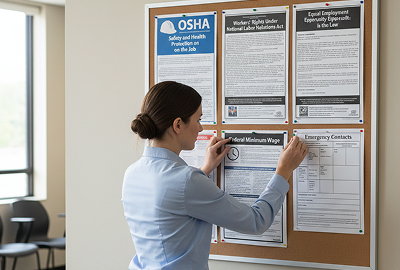
OSHA posting requirement is a very important workplace poster. It protects employers from staying compliant with federal and state laws, which applies to most U.S. workers.
Understanding the OSHA poster requirements is also very crucial, as it is not just about avoiding fines. It is about creating a transparent workplace where employers have the knowledge regarding their workplace rights and safety protections.
What Is the OSHA Poster and Why Is It Required?
The OSHA Job Safety and Health: It’s the law poster helps employers and employees to understand their rights under the Occupational Safety and Health Act of 1970. OSHA Act comes under federal law and requires employers to provide safe working conditions for employees. It also allows employees that they have the right to inform or report any hazard they face in their workplace without the fear of retaliation. Therefore, the poster must be displayed in every workplace covered by OSHA.
The OSHA poster requirement covers:
- The right to have a safe workplace that is free from safety hazards.
- The right to receive training in a language that workers understand.
- The right to review work-related injury or illness records.
- The right to file a complaint regarding unsafe conditions.
- Protection from retaliation for reporting safety concerns.
These posting obligations are not optional; they are important. If someone fails to display the required OSHA safety poster, they may face civil fines, penalties, and citations, as well as increased scrutiny during inspections.
Which Employers Must Comply with OSHA Poster Requirements?
Most of the private and some public sector employers are required to follow the Occupational Safety and Health Administration (OSHA) posting requirement.
1. Covered Employers
- Employers with one or more employees in most industries
- Construction, manufacturing, healthcare, hospitality, retail, and office environments
- Businesses located in multiple locations must post at each worksite
- Temporary and seasonal employers must post during active employment periods
2. Exemptions
Only a very few employers are exempt from OSHA poster requirements. Exemptions mainly apply to:
- A self-employed individual having no employees
- Immediate family members of farm employers working on family farms
- Certain state and local government employees in states that do not come under state plans.
Even an employer running a small business needs to comply with OSHA posting requirements, as there is no employee count threshold that exempts an employer from posting the OSHA notice.
3. Industry Specific Considerations
Certain industries face additional scrutiny:
- Construction sites: Posters must be displayed at each project location, including temporary field offices and trailers.
- Healthcare facilities: Compliance extends to clinics, hospitals, nursing homes, and outpatient centers.
- Manufacturing plants: Multi-shift operations require posters in areas accessible to all shifts.
Employers operating across state lines or managing franchises must ensure each location complies with both federal OSHA requirements and applicable state labor laws.
Where and How to Post OSHA Notices
According to the OSHA Act, employers are required to post the notices in a conspicuous place where employees can easily see the notice. It is also important to keep in mind that the notices should not be altered, deformed, or covered by other material.
1. Common Areas for OSHA Posting Requirements
| Requirement | Details |
|---|---|
| Visibility | Posters must be placed in areas where employees regularly come together, such as:
|
| Accessibility | The posters should be placed in such a way that employees are able to read them without any obstruction. |
| Multiple Locations | If you have multiple worksites or have multiple floors, employers are required to post notices in each worksite or location. |
| Damage Protection | Posters should be laminated or enclosed to prevent any damage. |
For worksites with restricted areas, such as warehouses, construction zones, or secure facilities, employers must ensure posters are placed where all workers can view them during their shifts.
2. OSHA Posting Requirement for Remote and Hybrid Workers
Employers with a remote or hybrid work setup need additional posting obligations. OSHA does not currently require physical posters for fully remote employees, but employers must provide equivalent access. Best practices for remote compliance include:
- Sending electronic copies of required posters to remote employees through email
- Notices should be posted on internal portals or intranets
- Providing downloadable PDFs of all required federal and state posters.
- Keeping documentation that remote workers received access to the required notices
Employers should note that remote workers may still need access to state-specific posters based on where they work, not where the company is headquartered.
3. Language Requirements
OSHA generally requires posters to be displayed in English. However, if a certain number of the workforce is not proficient in English, OSHA recommends posting the notice in the languages that the employees understand.
Employers with multilingual workforces should display both English and Spanish versions, or any other languages as that is needed, so that all employees can understand their rights.
WorkWise Compliance offers comprehensive labor law posters that include both English and Spanish versions of required federal and state notices, simplifying compliance for employers.
What Other Labor Law Posters Are Required Besides OSHA?
OSHA is one of the important federal posting requirements. Apart from OSHA posters, there are several federal posting requirements that are important for the workplace. Depending on the workforce size and industry, one may also need to display:
1. Federal Labor Law Posters Requirement
| Poster | Requirement | Covered Employers |
|---|---|---|
| Fair Labor Standards Act (FLSA) | Covers minimum wage, overtime, and child labor rules | Applicable to all employers covered by the FLSA. |
| Family and Medical Leave Act (FMLA) | Provides unpaid leave rights | Covered Employers have:
|
| Equal Employment Opportunity (EEO) | Ensures anti-discrimination protections | Relevant for employers with 15 or more employees covered by: Title VII of the Civil Rights Act of 1964 Americans with Disabilities Act (ADA) of 1990, Age Discrimination in Employment Act (ADEA), and more. |
| Employee Polygraph Protection Act (EPPA) | Imposes restrictions on lie detector tests | Applies to most private employers, with some exemptions. |
| USERRA | Covers military leave and reemployment rights | Applicable to all employers, regardless of size. |
2. State Labor Law Posters Requirement
State posting requirements vary widely. Many states require additional notices apart from federal posting, which mainly cover:
- State minimum wage and overtime rules
- Paid sick leave or family leave laws
- Workers' compensation information
- Unemployment insurance
- Whistleblower protections
Employers who are working at multiple locations are required to post multiple state posters required by that particular state. Failure to post required state-specific posters may result in fines and penalties. WorkWise Compliance provides state labor law posters updated to reflect the latest regulatory changes.
Industry-Specific and Local Posting Requirements
Certain industries or municipalities impose additional posting obligations:
- Federal contractors: Must display additional Equal Employment Opportunity (EEO) and wage notices
- Healthcare employers: May need OSHA bloodborne pathogen or tuberculosis notices.
Employers should review federal, state, and local requirements to ensure full labor law compliance obligations.
Consequences for Not Complying with OSHA Posting Requirements
Failing or not obeying OSHA poster requirements may result in citation, civil penalties, and other serious consequences:
1. OSHA Citations and Penalties
OSHA classifies penalties according to different types of violations. OSHA Penalties for missing or defaced posters are given below:
| Type of Violation | Maximum Penalty |
|---|---|
| Serious | $16,550 per violation |
| Other-Than-Serious | $16,550 per violation |
| Willful or Repeated Violation | $165,514 per violation |
| Posting Requirements | $16,550 per violation |
| Failure to Abate | $16,550 per day (30 days maximum) |
2. Increases the Risk of Inspection
Missing posters often trigger broader OSHA inspections. If an inspector notices a missing OSHA notice during a site visit, they may conduct a more thorough review of your safety programs, injury logs, and training records.
3. Complaints From Employee
Employees who are unaware of or facing any workplace safety hazard have the rights that they can file complaints with OSHA or state labor agencies. Complaints from employees will eventually lead to investigations, fines, and reputational damage.
4. Post-Incident Scrutiny
After a workplace injury or fatality, OSHA investigators review whether the employer met all posting requirements. Missing notices can be interpreted as a sign of broader safety negligence, increasing liability exposure.
Common Employer Mistakes and How to Avoid Them
Even well-intentioned employers make posting errors. Here are the most frequent mistakes:
1. Using Outdated or Incomplete Free Posters
Many employers download free posters from government websites, but most of the time fail to update them when laws change. This can lead to outdated posters; also, free posters does ot include state-specific notices, which are also important. It is advisable to use attorney-reviewed poster bundles that include all required federal and state notices. WorkWise provides regularly updated federal and state labor law posters to simplify compliance.
2. Posting Only Federal or Only State Notices
Some employers often believe that posting only federal or only state labor law posters makes them compliant with labor laws, but the truth is, both state and federal posters are equally important and are required to be posted in the workplace. Apart from state and federal labor law posters, some states also have local poster requirements. It is important to post all the required posters in your workplace to avoid any costly fines or penalties.
3. Failing to Update After Law Changes or Relocations
Labor laws change very frequently, either annually or in the middle of the year. Employers who fail to monitor those updates or forget to replace outdated posters risk violations. Therefore, many employers subscribe to compliance alert services that notify them of new posting requirements. WorkWise Compliance offers email alerts and compliance tracking to help employers stay current.
4. Not Replacing Damaged or Defaced Posters
Torn, faded, or illegible posters do not satisfy legal requirements. OSHA requires notices to be clearly visible and readable. Inspect posters regularly and replace damaged notices immediately. Laminated posters or enclosed bulletin boards help protect against wear and tear.
Conclusion
OSHA poster requirement is a foundational element of workplace compliance. If an employer takes all the posting obligations seriously and follows the required law, they will protect their workers from any safety hazard, it will also help them to reduce legal risk, and demonstrate a commitment to safety and transparency.
It is not necessary that to stay compliant one has to feel complicated. By using comprehensive poster bundles, subscribing to update services, and implementing centralized tracking systems, employers can simplify compliance and focus on running their businesses.
WorkWise Compliance offers multi-location compliance management solutions, whether you operate a single location or manage a multi-state workforce. WorkWise makes it easy to stay compliant and avoid costly violations.
FAQs
What size does the OSHA poster need to be?
OSHA does not specify an exact size for the poster. However, as per the OSHA official poster size, employers should use the official poster or a reproduction that must be reproduced at a minimum size of 8.5 inches by 14 inches, and the text must be no smaller than 10-point type.


