This website and our authorized third-party service providers use cookies to achieve the purposes described in our Privacy Policy. If you would like to learn more or withdraw your consent to some or all cookies, please review our Privacy Policy. By selecting “I ACCEPT” on this banner, scrolling this page, clicking any link, or continuing to browse this site, you agree to the use of cookies.
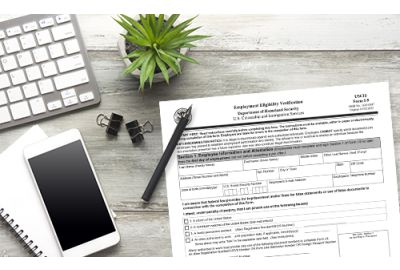
Recently, the Immigration and Customs Enforcement (ICE) announced an additional extension to Form I-9 compliance. The May 27 announcement is similar to extensions granted throughout 2020 involving Form I-9 compliance flexibilities during the pandemic. However, due to continued COVID-19 precautions, the Department of Homeland Security (DHS) will extend this policy until August 31st, 2021.
Background on Original Extension
On March 19th, 2020, due to COVID-19 precautions implemented by employers and employees, the DHS announced the original extension. Subsequently, after that date, the agency would exercise prosecutorial discretion to defer physical presence requirements associated with Form I-9 compliance. In other words, when employers receive and review Form I-9 documents, the items would not need to be physically present. However, this temporary policy change only applies to employers and workplaces operating remotely. On the other hand, if employees are physically present, identity and employment eligibility verification extensions were not granted.
Specifically, under the original extension requirements, employers in remote workplaces must inspect Form I-9, Section 2 documents remotely. Most importantly, they must obtain, review, and retain document copies within three business days to complete Section 2. Markedly, employers should enter “COVID-19” as the reason for the physical inspection delay in Section 2 Additional Information. However, the notation should happen once a physical inspection occurs after normal operations resume.
Once the employer physically inspects the documents, they should note “documents physically examined” with the corresponding date. The employer should add the comment to the Form I-9 Section 2 additional information field or Section 3.
Employer Takeaways
In conclusion, employers providing remote work must provide written documentation of their onboarding and telework policy for each employee. This burden rests solely with the employers. Once normal operations resume, all employees onboarded using remote verification must report to their employer within three business days. Then, the in-person validation of identity and employment eligibility documentation for Form I-9 must occur.
In the meantime, as it has since March 2020, the DHS will continue to monitor the ongoing coronavirus pandemic. The agency will provide additional or updated guidance for employers, as needed, regarding I-9 compliance. Accordingly, employers should watch DHS and ICE websites for other updates regarding the termination of any extensions.
Practical articles on HR, Safety, compliance, and people operations—written for real businesses, not legal textbooks.
U.S. Department of Labor Officially Restores Prior Overtime Exemption Rules
On May 14th, 2026, the Wage and Hour Division (WHD) of the U.S. Department of Labor (DOL) announced it has officially rescinded the 2024 overtime exemption rules. Specifically, the WHD published a technical amendment to restore previous 2019 regulations that dictated overtime exemptions for...
NLRB General Counsel Takes Action to Tackle Current Case Backlog
On May 6th, the National Labor Relations Board (NLRB) and NLRB General Counsel Crystal Stowe Carey announced the bulk transfer of thousands of labor practice cases. Specifically, this action fulfills an initiative signed by the NLRB General Counsel earlier this year. Overall, the initiative...
Privacy Agency Invites Comments from Businesses on the CCPA’s Usage of Personal Data
Recently, the California Privacy Protection Agency (CPPA) issued a call for comments on the current state of personal data collection under the California Consumer Privacy Act (CCPA). Specifically, the invitation to deliver remarks was issued on April 20th, 2026. The information provided by the...
DOL Proposes New Joint Employer Rule To Unify Standards Under Federal Labor Laws
In April 2026, the U.S. Department of Labor issued a proposed rule to establish a single, clear standard for determining when joint-employer status applies under three major federal laws: the Fair Labor Standards Act (FLSA), the Family and Medical Leave Act (FMLA), and the Migrant and Seasonal...
DOL Updates Enforcement Approach for Employee Benefit Plans: What Employers Should Know
The U.S. Department of Labor (DOL) recently announced a significant change in its enforcement of employee benefit plan rules. The DOL will now focus more closely on serious violations that harm workers and retirees, meaning compliant employers may face less scrutiny under the updated approach.